


Places and sights
Discover
Start with real places: squares, walls, gates, churches, museums, lanes, viewpoints and distinctive details.
Interactive old town
Explore Rothenburg in 3D
Choose a category to explore its places in the 3D model. Select a place to open its article.
Drag to rotate · Scroll to zoom · Right-drag to pan. On touchscreens: one finger rotates, two fingers zoom and pan. You can also open places using the selection list.
Explore by topic
Gates & Towers
City gates, towers, passages and viewpoints of Rothenburgs fortifications.

Town Hall and Town Hall Tower
The town hall on the market square is one of the most impressive buildings in Rothenburg ob der Tauber. What is particularly interesting is that at first glance it looks like a single building, but in fact it consists of different construction phases. Gothic and Renaissance stand side by side here. The town hall tower rises above the older part. Anyone who manages the approximately 220 steps to the top will be rewarded with one of the most beautiful panoramic views of the old town.

The Plönlein and Siebers Tower
The Plönlein is probably the most famous photo motif in Rothenburg ob der Tauber and has become a symbol of the city for many people around the world. The narrow half-timbered house, the small fountain in front of it and the two streets that split in different directions behind it, together with the Siebersturm and Kobolzell Gate, form one of the most distinctive historical cityscapes in Germany.

Markus Tower – A Remnant of Rothenburg's First Fortifications
The Markus Tower with the Röder Arch is one of the oldest traces of the Rothenburg city fortifications. Today the ensemble stands in the middle of the old town – but this is where an early border of the city once ran. Those who pass through the wing arch cross an area that was already fortified long before Rothenburg reached its current size.
Explore by topic
Museums
Museums, collections and places with deeper exhibitions.

Medieval Crime and Justice Museum
The Medieval Crime Museum is one of the most unusual and at the same time most interesting museums in Rothenburg ob der Tauber. Anyone who only expects a collection of cruel torture instruments is clearly underestimating the museum. On several floors, it tells of more than 1,000 years of German and European legal history - from medieval court proceedings, shameful punishments and torture to witch trials, executioners, prison sentences and the development of modern legal ideas. With around 50,000 exhibits, the museum is one of the most important legal museums in Europe.

RothenburgMuseum
If you don't just want to look at Rothenburg ob der Tauber, but really understand it, you should visit the RothenburgMuseum. On more than 2,500 square meters, the museum tells of several centuries of city history - from medieval monastic life and the time as an imperial city to Jewish life, crafts, art and historical weapons to the tourist rediscovery of Rothenburg and the reconstruction after the Second World War.

Historic Vault and State Dungeon
Directly beneath the Rothenburg town hall there is a sight that connects two very different chapters in the city's history. The history vaults are primarily about Rothenburg during the Thirty Years' War and the dramatic events of 1631.
Explore by topic
Churches
Churches, chapels, sacred spaces and religious history.

St. James's Church
The St. Jacob's Church is one of the most important buildings in Rothenburg ob der Tauber. Its two towers shape the silhouette of the old town, but the real treasures are inside: centuries-old stained glass windows, several late Gothic altars and, above all, the famous Holy Blood Altar by Tilman Riemenschneider. The Gothic church was built for more than 170 years. It began in 1311 and the building was completed and consecrated in 1485. Originally Catholic, St. Jakob became Protestant during the Reformation and is still the main Evangelical Lutheran church in Rothenburg today.

St. John's Church
The St. Johannis Church is one of the sights in Rothenburg that appears rather inconspicuous from the outside and is therefore easily overlooked. The building tells an extraordinary story: Its origins lie with the medieval Order of St. John, later the church became Protestant, its roof was converted into a huge urban granary - and since 1803 it has once again served as a church for Rothenburg's Catholic community.

Franciscan Church
The Franciscan Church is one of the oldest surviving churches in Rothenburg ob der Tauber and differs significantly from the monumental St. Jacob's Church. Instead of size and representation, simplicity, clear shapes and a calm atmosphere determine the interior. This corresponds exactly to the original idea of the Franciscan order, which consciously strived for a life of poverty and modesty.
Explore by topic
City Wall
Walls, walkways, bastions and the defensive logic of the town.

Explore by topic
Squares & Lanes
Squares, lanes, fountains and defining areas of Rothenburg old town.

Chapel Square
In the Middle Ages, the Kapellenplatz belonged to the center of Rothenburg’s first Jewish community. Here stood a synagogue and an important Talmud school, where Rabbi Meir ben Baruch of Rothenburg taught. After the persecutions of the 14. In the 19th century, the synagogue was converted into the Marienkapelle – from it the square received its current name.

Green Market – Historic Trading Place behind Town Hall
The Green Market is located between Town Hall and St. Jacob's Church in the heart of Rothenburg's old town. Already in the Middle Ages, food was traded here. Today, the square is especially lively during events – from the historical craft market to the wine village to the Reiterlesmarkt.

Market Square – The Heart of Rothenburg
If there is one place where almost every Rothenburg visit takes place at some point, it is the marketplace. This is where the main streets of the old town meet, where the mighty town hall stands, where city tours begin – and there is usually more going on here than at any other place in the city. The marketplace is not just a sight. It is still a real meeting place today.
Explore by topic
History
Historical background, connections and developments of the town.

1407 – Six Weeks before the Walls of Rothenburg
In the summer of 1407, the war approached Rothenburg directly. Powerful opponents from Würzburg and the House of Hohenzollern attacked the Rothenburg Land, conquered castles, destroyed crops and finally tried to bring the imperial city to its knees. Behind the walls, people from the surrounding countryside sought shelter, while outside an army set out to starve Rothenburg. It was not a war of great battles – but a grueling battle for supplies, time and endurance.

1631 – When Tilly Stood before Rothenburg
In the autumn of 1631, Rothenburg fell into the midst of the Thirty Years' War. The city had placed itself under Swedish protection – shortly afterwards, Johann T’Serclaes von Tilly, one of the most feared generals of his time, stood before the walls. The Council refused the handover and hoped for help from Würzburg. This was followed by shelling, assault and anxious hours behind the fortifications. When the expected rescue turned out to be imperial reinforcements, only capitulation remained. Rothenburg was plundered – but not destroyed. From these dramatic days later emerged the famous legend of the master drink.

Heinrich Toppler
Heinrich Toppler was one of the most powerful figures in Rothenburg’s history. As mayor, diplomat and major landowner, he played a decisive role in the rise of the Imperial City and helped expand its territory far beyond the city walls. But his career came to an abrupt end: in 1408, Toppler was arrested by Rothenburg’s own town council. Just a few weeks later, he died in the prison beneath the Town Hall – and to this day, no one knows for certain what happened there.
Explore by topic
Medieval City
Daily life, supply, trade, crafts, administration and defense in the medieval city.

How Did an Entire City Sustain Itself?
A medieval city could not exist within its walls alone. Grain, meat, wood, wool, leather and other raw materials were needed every day. Blacksmiths needed iron and charcoal, bakers needed flour, tanners needed animal skins and bark, and builders needed stone, lime and wood. But where did all this come from? Rothenburg was not a closed city behind a wall, but the center of a much larger economic system. Around the city were fields, pastures, forests, fish ponds, quarries and villages. Numerous mills worked in the Tauber Valley. Traders came through the city gates with goods that could not be produced or obtained locally. The large rural area of the imperial city became particularly important. In the late 14th and early 15th centuries, Rothenburg brought an area of almost 400 square kilometers under its control. In this way, the city not only secured political influence, but also a large part of its supplies.

Medicine, Welfare and Education in Medieval Rothenburg
Today, visits to the doctor, pharmacy and schooling are part of everyday life. But what did it look like in medieval Rothenburg? What happened if someone became seriously ill, injured, or needed medical attention? Were there already pharmacies - and who manufactured the medicines? And could children even learn to read and write back then? Even in the Middle Ages, Rothenburg was much more than a city of walls, towers, churches and craftsmen's houses. Doctors, pharmacists, spas, hospitals and schools were part of an astonishingly complex urban system. Medicine and education worked completely differently than they do today, but they are a particularly good example of how organized life was in a late medieval imperial city.

How Rothenburg Pumped Water Uphill
Rothenburg lies high above the Tauber Valley - an ideal location for defense, but a problem for the water supply. Because the water was where it naturally flowed: down in the valley. A technically remarkable solution was therefore created at the end of the 16th century. With the power of the Tauber, spring water was pumped many meters up to the Klingentor Tower via a pumping station. From there it spread further into the city via pipes and wells. An early technical masterpiece that shows how sophisticated the supply of Rothenburg was already organized more than 400 years ago.
Explore by topic
More Sights
More places worth seeing and selected background about Rothenburg.

Athis-Mons Park – Green Space along the Historic Moat
Directly outside the city walls between Gallows Gate and Kummereck lies the Athis-Mons complex. The small green area with trees, beds and walking paths follows the historical moat of the Rothenburg city fortifications and offers a quiet view of walls and towers. It bears its name in honour of the French twin town of Athis-Mons, with which Rothenburg has been associated since 1976.

Monastery Garden – Behind the Walls of the Former Dominican Convent
In the middle of the old town and yet surprisingly quiet is the monastery garden next to the RothenburgMuseum. Lawns, old trees, herb beds and historical monastery walls create a protected retreat just a few minutes from the market square. At the same time, the garden is reminiscent of the former Dominican monastery and the monastery church that once stood on this site.

Old Town Moat between Röder Gate and Gallows Gate
Outside the eastern city wall, a quiet green area stretches between Röder Gate and Gallows Gate along the former city moat. Away from the busy alleys of the old town you will find trees, lawns and a path directly at the historical fortification. A playground at the Gallows Gate also makes the area interesting for families, and for a walk with a dog, the more spacious surroundings offer significantly more space than the narrow streets within the city walls. The atmosphere of the historical festival changes: Parts of the green areas are then used by festival groups and are reminiscent of earlier times with camps and historical representations.
Explore by topic
Routes
Walking routes, themed paths and practical tours through Rothenburg.

City Wall Tour
The Rothenburg City Wall surrounds the historic old town for about four kilometres. But a complete round does not run exclusively on top of the wall. Our city wall tour therefore connects the most beautiful walk-in military passages with gates, towers and bastions – and continues where the city wall is no longer walkable, via a scenic particularly beautiful panoramic path outside the old town.
Rothenburg – A Day Trip through the Old Town
Do you have about six hours for Rothenburg? Then the stay is not only enough for the most famous sights, but also for a closer look at the history of the city. In addition to Market Square, Plönlein and the historical alleys, this route leads to the castle garden, to several city gates and to the city wall. With the RothenburgMuseum, a museum visit is also planned, for which you can easily provide one to two hours.

Rothenburg in Two Hours – The Top Sights
You only have about two hours for Rothenburg? This is enough for a very good first impression. The route connects some of the main attractions with particularly characteristic streets of the old town. It is intended as a tour – You can therefore board at any point and adjust the order of your arrival accordingly.
Explore by topic
Events
Events and seasonal reasons to visit Rothenburg.
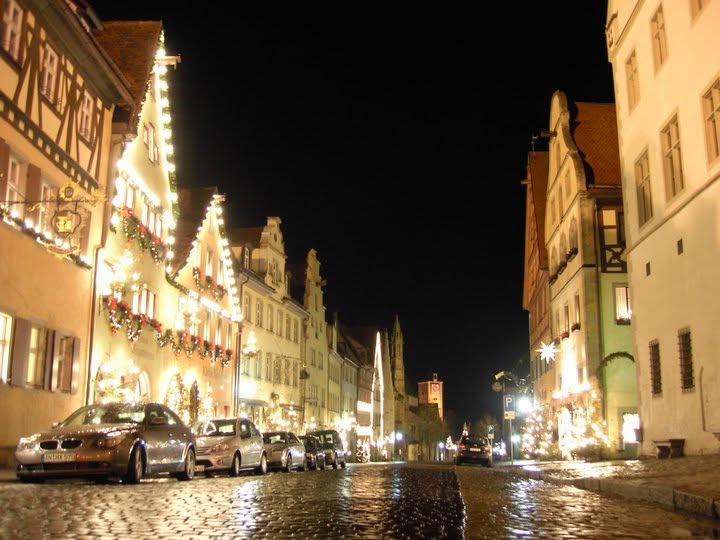
Rothenburg Christmas Market
Christmas market (Reiterlesmarkt) in Rothenburg ob der Tauber from November 20th, 2026 to December 23rd, 2026

Imperial City Festival in Rothenburg ob der Tauber
From 3 to 5. In September 2027, Rothenburg ob der Tauber is transformed into a major historical stage at the Reichsstadt festivals. More than a thousand participants bring different eras of the city’s history back to life – with historical camps, crafts, music, fencing, parades and scenes from more than 700 years of Rothenburg history.

“Der Meistertrunk” Historical Festival
The historical festival “Der Meistertrunk” transforms the Rothenburg old town into a big stage on Pentecost.
Explore by topic
Arrival & Parking
Arrival, train connections, parking and ways into the old town.
 AI-generated image
Parking outside Rothenburg's Old Town
Around the historic old town of Rothenburg ob der Tauber, five large public parking spaces are available for visitors. Parking spaces P1 to P5 are located outside the city walls, so visitors can park their car and explore the old town on foot. Which car park is most suitable depends mainly on which direction you come from and which part of Rothenburg you want to visit first.
 AI-generated image
Travelling by Car
Rothenburg ob der Tauber is located just a few kilometres from the A7 motorway and is easily accessible by car from many parts of Germany. If you want to reach your destination quickly, take the motorway to the exit Rothenburg ob der Tauber. If, on the other hand, you already want to make the journey part of the holiday, you can change from Würzburg, Frankfurt or Munich to the Romantische Straße and drive through smaller cities and the Frankish countryside to Rothenburg.
 AI-generated image
Travelling to Rothenburg ob der Tauber by Bus
Rothenburg ob der Tauber can also be reached by bus. In addition to regular long-distance and regional bus connections, there are mainly organized day trips that serve Rothenburg from Munich, Frankfurt or Würzburg, for example. Especially these tours can be interesting if you do not want to take care of your own arrival and return journey and want to connect Rothenburg with other stations along the Romantic Road.
Explore by topic
Coach Tours
Bookable coach tours, excursions and organized trips to Rothenburg.
 AI-generated image
Day Trip from Munich to Rothenburg via the Romantic Road
Visit Rothenburg as a day trip from Munich. The approximately 10.5-hour bus trip connects the Romantic Road, Harburg Castle and around two hours of free time in Rothenburg's old town.
 AI-generated image
Day Trip from Frankfurt to Rothenburg via the Romantic Road
Discover Rothenburg on a full-day bus trip from Frankfurt along the Romantic Road. Via Weikersheim and Röttingen you go to Rothenburg, where you have around three hours to explore the old town on your own.
AI-generated image Day Trip from Würzburg to Rothenburg via the Romantic Road
Discover Rothenburg on a day trip from Würzburg along the Romantic Road. The 7.5-hour bus trip takes you via Weikersheim and Röttingen and offers around three hours of free time in Rothenburg's old town.
Explore by topic
Guided Tours
Guided city tours and hosted experiences.
 AI-generated image
Private Night Watchman Tour of Rothenburg
Experience Rothenburg after dark with a private night guard. On the one-hour walking tour of the old town you will learn more about city defense, medieval dangers and life within the walls.
 AI-generated image
Private Walking Tour of Rothenburg ob der Tauber
Discover Rothenburg on a private 90-minute walking tour. From the Georgsbrunnen it goes to well-known sights such as Market Square, Town Hall, St. James's Church, Plönlein and town wall – with a route that can be adapted to your interests.

Private Walking Tour of Rothenburg ob der Tauber – Discover the Historic Old Town
Discover Rothenburg ob der Tauber on a 90-minute private walking tour with a knowledgeable local guide. Wander through picturesque streets, admire historic half-timbered houses, and explore famous landmarks such as the Plönlein, Market Square, and the medieval city walls. The tour can be tailored to your personal interests.
Explore by topic
More to discover
More selected places, stories and topics for your visit to Rothenburg.
